Short answer: yes, and nobody needs to be told you are coming or why. People walk into Archangel Michael Orthodox Church in Broadview Heights every weekend without being Orthodox. Some arrive alongside an Orthodox spouse or friend; some are Catholic or Protestant measuring the Orthodox Church in America against the church they grew up in, and others have spent months reading about the faith online and finally decided to see it in person. The Divine Liturgy is public worship, so attending asks nothing more of you than walking in and finding a place to stand.
What follows is what most non-Orthodox visitors actually want settled before a first Sunday: who is welcome, how much you can join in, the single moment set aside for Orthodox Christians, and how little is really asked of a guest.
Who counts as "non-Orthodox"?
“Non-Orthodox” simply means anyone who has not been received into the Orthodox Church. That includes Roman Catholics, Protestants of every denomination, non-denominational Christians, members of other faiths, and people with no religious background at all. Every one of them is welcome to attend a service. You do not need to be baptized, you do not need to register ahead of time, and you do not need to share the Church’s beliefs in order to be present at worship.
The Divine Liturgy is public worship, and the doors are open. Whether you are researching Orthodox Christianity out of academic interest, accompanying an Orthodox friend or spouse, or quietly considering the faith for yourself, you will be received the same way. If you would like to understand the tradition you are stepping into before you come, our overview of what Orthodox Christianity is and how the faith took shape explains the history and core beliefs in plain language.
What you can and cannot take part in
This is usually the real hesitation, and the answer is straightforward: almost everything in the service is open to you. You can take part as fully or as quietly as you like. You may stand, sit, listen, pray, sing the responses, light a candle, and venerate (kiss) the icons if you feel moved to, or you may simply find a quiet place toward the back and observe. The only part of the service set aside specifically for Orthodox Christians is Holy Communion. The quick reference below sums it up.
| Part of attending | Open to non-Orthodox visitors? |
|---|---|
| Attending the Divine Liturgy or Vespers | Yes, always |
| Lighting a candle and venerating the icons | Yes, if you wish |
| Standing, sitting, bowing, and praying along | Yes, at your own comfort |
| Receiving antidoron (blessed bread) at the end | Yes, everyone is invited |
| Staying for coffee hour to meet the parish | Yes, please do |
| Asking the priest questions before or after | Yes, always welcome |
| Receiving Holy Communion (the Eucharist) | Reserved for prepared Orthodox Christians |
In other words, the boundary is narrow and specific. It is not a barrier to attending, taking part, or being made to feel at home. It concerns one moment, and even in that moment a visitor is not just a bystander, as the next section explains.
Why Communion is reserved for Orthodox Christians
In the Orthodox Church, receiving Holy Communion is an expression of full unity with the Church’s faith and life, not only a private act of personal devotion. Because the Eucharist signifies that shared faith, it is offered to those who have been received into the Church and who prepare to receive it through prayer, fasting, and confession. This practice is not a judgment on the sincerity or the Christianity of any guest. It reflects what the Orthodox Church understands communion to mean: a visible sign that those approaching the chalice already share one faith.
Visitors are never left out of the welcome, though. When communion has been offered to the faithful, everyone present, Orthodox or not, is invited to come forward at the end of the Liturgy to receive a piece of antidoron, the blessed bread shared as a sign of fellowship and affection toward all who have gathered. If you would like to see exactly how this fits into the flow of worship, the Orthodox Church in America publishes a prayer-by-prayer walkthrough of the Divine Liturgy, and our own guide to what to expect at an Orthodox church service describes the two halves of the service step by step.
What is expected of a visitor (almost nothing)
Practically nothing. There are no assigned seats, no collection plate pushed down the row, and no point where a newcomer is asked to stand or introduce themselves. Orthodox Christians stand for much of the service and cross themselves at certain moments, but a visitor who simply stands, watches, and follows the people nearby is doing exactly the right thing.
There is no strict dress code either. Most worshippers dress modestly and a little more formally than they might for a casual weekend, which is simply a sign of reverence, and clothing that covers the shoulders and knees is a safe choice for anyone. Our parish answers the common question of what to wear to the liturgy in more detail if you would like it. It also helps to arrive a few minutes early so you can settle in before the service begins.
Visiting Archangel Michael Orthodox Church near Cleveland
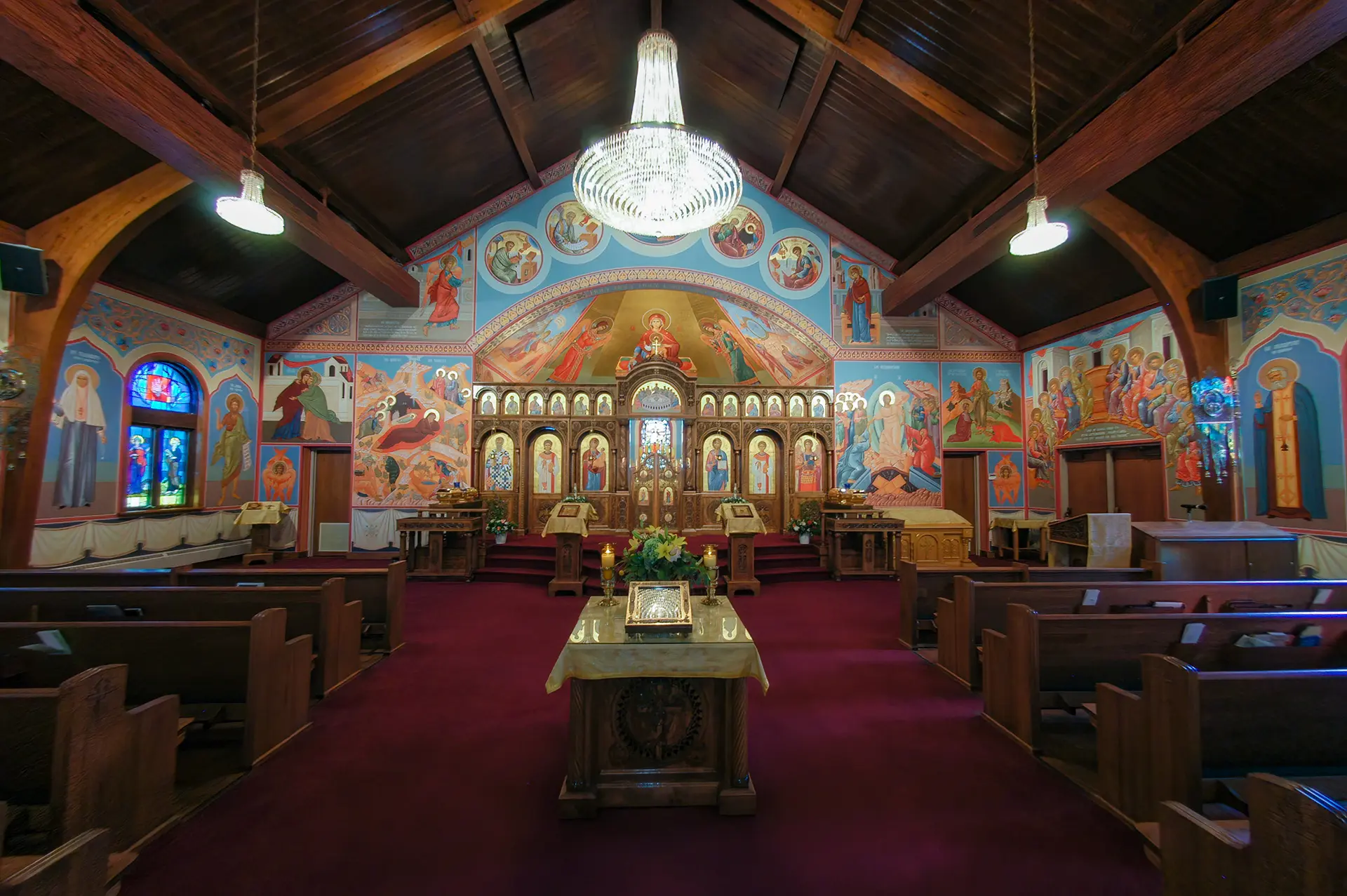
If you are exploring Orthodoxy anywhere in the Cleveland area, we would be glad to welcome you in person. Archangel Michael Orthodox Church has served Greater Cleveland for more than a century from its home at 5025 East Mill Road in Broadview Heights. Our weekend services are Vespers on Saturday at 5:00 PM and the Divine Liturgy on Sunday at 9:30 AM, and visitors are welcome at either one.
You do not need to be Orthodox, register in advance, or know what to do. Come to a service, stand or sit wherever you like, receive the blessed bread at the end, and stay for coffee afterward to introduce yourself and ask anything you are wondering about. Our pastor says the same in his own words in his greeting to newcomers, and you can confirm the current service schedule before you come, since feast days occasionally shift the timing.
Frequently Asked Questions
Yes. Anyone is welcome to attend Orthodox services, including the Divine Liturgy, regardless of their religious background. You do not need to be Orthodox, baptized, or registered, and you do not need to know the prayers or rituals to walk in and observe.
No. Holy Communion is reserved for Orthodox Christians who have prepared to receive it through prayer, fasting, and confession. Non-Orthodox visitors are instead invited to receive antidoron, the blessed bread offered to everyone present at the end of the Divine Liturgy as a sign of fellowship.
No. Visitors are not expected to know the service or follow along perfectly. You may stand, sit, and pray at your own comfort, and no one will single you out. Worshippers stand, venerate icons, and make the sign of the cross, but none of this is required of a guest.
There is no strict dress code. Most worshippers dress modestly and somewhat formally as a sign of respect, and clothing that covers the shoulders and knees is a safe choice for any visitor. You will be welcomed regardless of what you wear.
Yes. Catholics, Protestants, and Christians of any tradition are welcome to attend Orthodox services. Like all non-Orthodox guests, they do not receive Holy Communion, but they are invited to take part in the rest of the worship and to receive blessed bread at the end.
Plan a First Visit
You will learn more in ten minutes inside the church than from any article about it. Chant, incense, and candlelit icons are hard to picture secondhand and simple to take in once you are standing there. Come to Vespers on a Saturday evening or the Divine Liturgy on a Sunday morning, stand wherever you like, and find the priest or anyone at coffee hour afterward with your questions. When you are ready, reach out and plan a visit.