What Is the Divine Liturgy?
The Divine Liturgy is the central worship service of the Orthodox Church, the equivalent of a Sunday Mass or morning service in Western churches. It is a celebration of the Eucharist (Holy Communion) that has been prayed in essentially the same form for more than 1,500 years.
Most Sundays you will attend the Divine Liturgy of St. John Chrysostom, the standard service of the Eastern Orthodox Church. A slightly longer service, the Divine Liturgy of St. Basil the Great, replaces it on ten specific days each year, including the Sundays of Great Lent and the eves of Christmas and Theophany. If you visit on an ordinary Sunday. If you visit on an ordinary Sunday, you will almost certainly experience the Liturgy of St. John Chrysostom.
The liturgy is not a performance you watch from a distance. It is a single, continuous act of worship in which the whole congregation participates through prayer, song, and movement. Understanding that structure ahead of time makes a first visit far less intimidating.
Before You Arrive: What First-Time Visitors Notice
A few features of Orthodox worship surprise newcomers, so it helps to know them in advance.
There are no assigned seats and no offering plate passed down the rows. People arrive, light a candle, venerate (kiss) an icon near the entrance, and then find a place to stand. You are welcome to do the same or simply find a quiet spot toward the back and observe. No one will single you out or expect you to know the choreography.
You will also notice that Orthodox Christians traditionally stand for much of the service, though chairs and pews are available for those who need them. People make the sign of the cross at certain moments and bow during specific prayers. None of this is required of a visitor. The unspoken rule is simple: when in doubt, stand quietly and follow along at your own pace.
Try to arrive a few minutes early. In many parishes a shorter morning service called Orthros (also known as Matins) is chanted right before the Divine Liturgy begins, so the worship is often already underway when the main service formally starts.
What Happens During an Orthodox Church Service, Step by Step
The Divine Liturgy unfolds in two major movements, each with its own focus. Knowing the order helps you follow the flow even if the words are unfamiliar. The Orthodox Church in America publishes a full walkthrough of the Divine Liturgy, prayer by prayer, if you would like to follow along in detail.
The Opening and the Liturgy of the Word
The service begins with the priest’s blessing and a series of litanies, short petitions to which the choir or congregation responds, usually with “Lord, have mercy.” This first half centers on Scripture. There are readings from the Epistles and the Gospel, often followed by a sermon that explains the day’s reading and how it applies to ordinary life.
Throughout this section you will see the priest and altar servers moving in and out of the sanctuary through the iconostasis, the icon-covered screen that separates the altar from the nave. Its central doors are called the Royal Doors, and they open and close at meaningful points in the service to mark the rhythm of the worship.
The Liturgy of the Eucharist
The second half builds toward Holy Communion. The gifts of bread and wine are carried in procession, the congregation recites the Nicene Creed together, and the priest offers the central Eucharistic prayer, asking the Holy Spirit to bless the gifts. This is the heart of the service.
When communion is offered, members of the Orthodox Church who have prepared through prayer and fasting come forward to receive. Visitors who are not Orthodox do not receive communion, but you are warmly invited to come forward at the end for a piece of blessed bread (antidoron), a gesture of fellowship extended to everyone present. The liturgy closes with final prayers, the priest’s blessing, and an invitation to coffee hour, where you can meet the community and ask questions.
The Sights, Sounds, and Smells of Orthodox Worship
For most visitors, the first encounter with Eastern Orthodox worship is sensory before it is intellectual. The faith is designed to be experienced with the whole body, not only the mind.
The music is almost entirely sung. Traditional Orthodox services use no instruments; instead, a choir and the congregation carry centuries-old hymns through unaccompanied chant. The melodies repeat and layer in a way that many newcomers describe as prayerful and calming rather than concert-like.
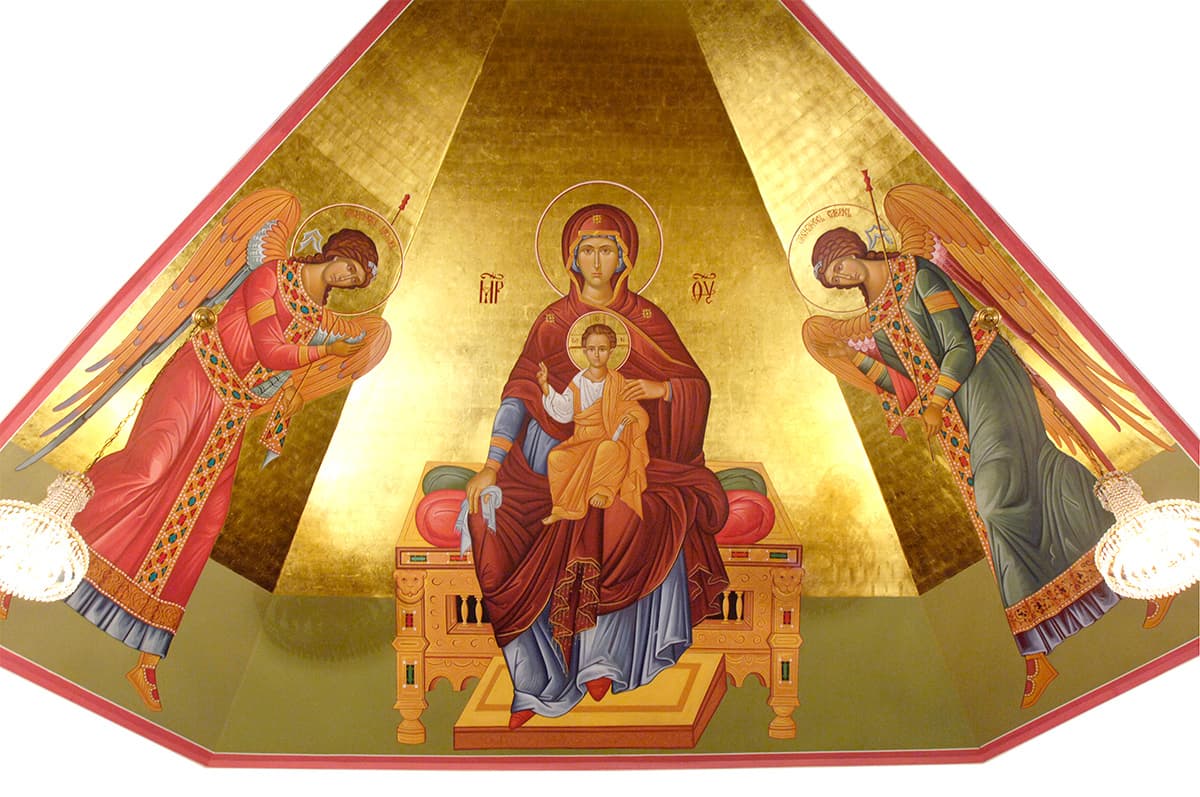
Incense is used frequently, both as an act of honor and as a visible image of prayers rising to God. Candlelight flickers in front of the icons that cover our walls, each one a window into the life of Christ, the Theotokos (the Virgin Mary), and the saints. Together, the chant, the incense, the candlelight, and the iconography create an atmosphere that engages every sense at once. If you would like a preview before visiting in person, you can watch a Divine Liturgy livestream from home.
Vespers, Matins, and the Weekly Rhythm of Services
The Divine Liturgy is the most important Orthodox service, but it is not the only one. Worship follows a weekly and seasonal rhythm that includes evening and morning prayer.
Vespers is the evening service that opens the liturgical day, typically served on Saturday evenings. Matins (or Orthros) is the corresponding morning service. At our parish, the usual weekend pattern is Vespers on Saturday at 5 PM and the Divine Liturgy on Sunday at 9:30 AM. During seasons such as Great Lent and the Nativity Fast, additional services are added, and the tone of worship shifts to match the season of prayer and fasting. You can always view our current service schedule before you plan a visit, since feast days occasionally change the timing.
This rhythm is one of the things that draws people to Orthodox tradition. Worship is not a single weekly event but a continuous cycle that shapes the entire week around prayer.
What to Wear and How to Participate as a Visitor
There is no formal dress code, and you will not be turned away for how you are dressed. That said, most worshippers dress modestly and a little more formally than they might for a casual weekend, which is simply a sign of reverence for the service. If you would like more detail, our parish answers a common question about what to wear to the liturgy directly.
As a visitor, you are free to participate as much or as little as you feel comfortable. You may stand, sit, sing along with the responses, or simply watch. The one thing to keep in mind is that Holy Communion is reserved for Orthodox Christians who have prepared to receive it, but everyone is welcome to receive the blessed bread and to share in coffee hour afterward.
If you want a deeper foundation before you come, our complete guide to what Orthodox Christians believe and how the faith took shape explains the history, core beliefs, and traditions behind everything you will see in the service.
Visiting Archangel Michael Orthodox Church Near Cleveland
If you are exploring Orthodoxy in the Cleveland area, we would be glad to welcome you. Archangel Michael Orthodox Church in Broadview Heights has served Greater Cleveland for more than a century, and our invitation to visitors has always been the same two words: “Come and see.”
You do not need to be Orthodox, register in advance, or know what to do. Join us for Vespers on Saturday evening or the Divine Liturgy on Sunday morning, stand wherever you like, and stay for coffee afterward to introduce yourself. Curiosity is the only requirement. When you are ready, plan your first visit and view our service times, and feel free to reach out with any questions beforehand.
Frequently Asked Questions
An Orthodox church service, called the Divine Liturgy, centers on Holy Communion and unfolds in two parts: the Liturgy of the Word, with Scripture readings and a sermon, and the Liturgy of the Eucharist, which builds toward communion. Worshippers sing hymns, venerate icons, and pray together throughout. A typical Sunday liturgy lasts around ninety minutes.
A Sunday Divine Liturgy usually runs about ninety minutes, though the total time can vary by parish and by season.
There is no strict dress code, but most people dress modestly and somewhat formally as a sign of respect. Clothing that covers the shoulders and knees is a safe choice for any visitor. You will be welcomed regardless of what you wear, so comfort and modesty are the only real guidelines.
No. Holy Communion in the Orthodox Church is reserved for Orthodox Christians who have prepared through prayer and fasting. Visitors are warmly invited, however, to come forward at the end of the service to receive a piece of blessed bread (antidoron) as a sign of fellowship and welcome.
Vespers is the evening prayer service that begins the liturgical day, often served on Saturday evening. Matins (also called Orthros) is the morning service that frequently precedes the Sunday Divine Liturgy. Both are part of the daily cycle of prayer that shapes Orthodox worship throughout the week.
Come and See for Yourself
Reading about an Orthodox church service can prepare you, but the liturgy was never meant to be understood from a page alone. It is meant to be seen, heard, and entered into. Whenever you are ready, join us in person, and let our community welcome you the way the faith has welcomed seekers for twenty centuries.