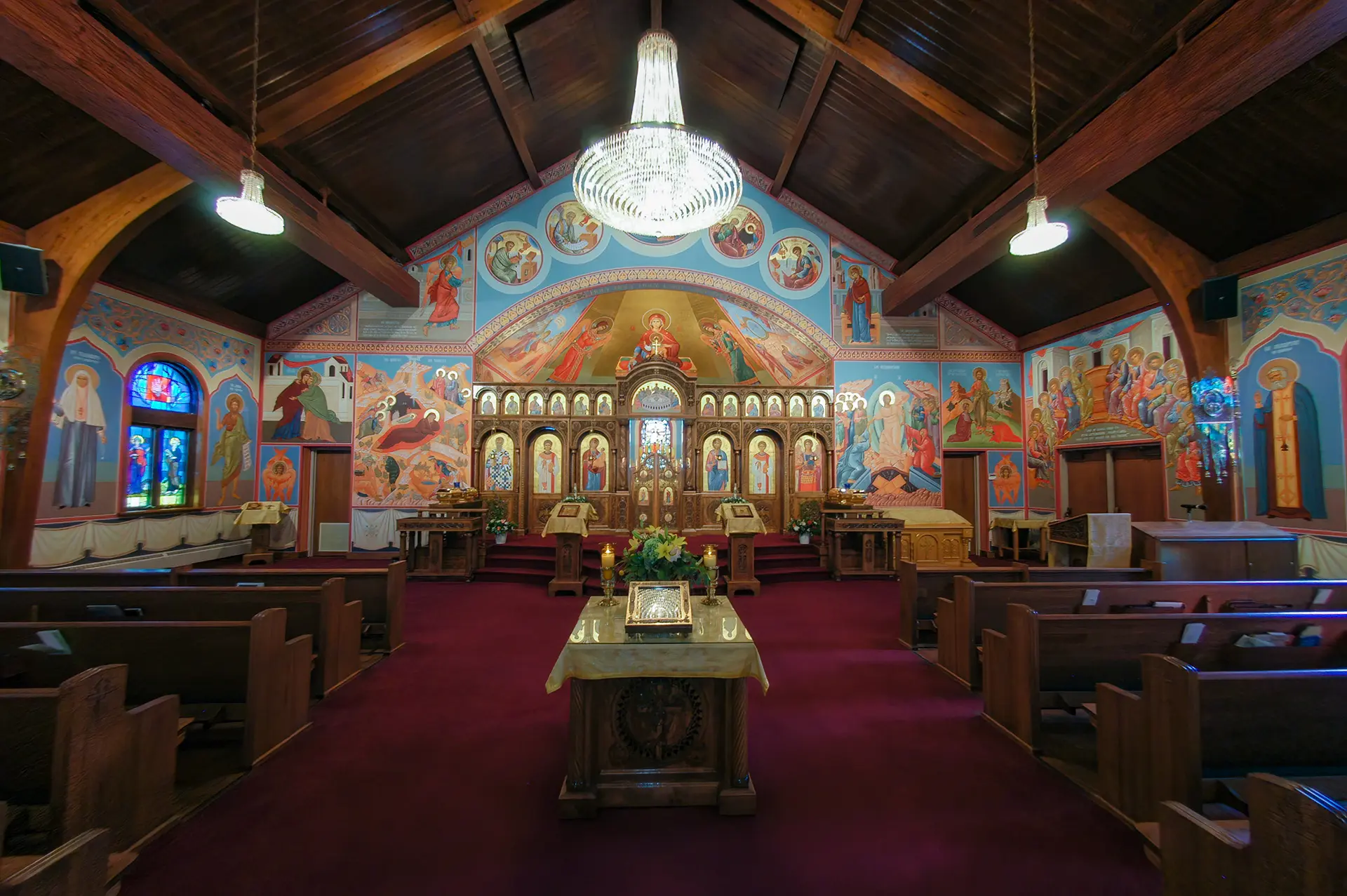
At Archangel Michael Orthodox Church, the question we hear most often from visitors is simply, “What is Orthodox Christianity?” It is the world’s second-largest Christian communion and one of the oldest continuously practiced faiths on earth, with roughly 260 million believers worldwide. We trace our unbroken line back to the apostles and the Church of the first century.
If you have wondered what we as Orthodox Christians actually believe, how our worship differs from other churches, and why so many people are discovering the faith today, this guide answers those questions in plain language.
What Does “Orthodox” Actually Mean?
The word “Orthodox” comes from two Greek roots: orthos (“right” or “correct”) and doxa (“belief” or “glory”). Together they mean “right belief” and “right worship.” The name reflects how we understand ourselves: not as a new denomination, but as the continuation of the Church that Christ founded and that the New Testament describes, preserving the same faith, sacraments, and worship handed down across twenty centuries.
You will also hear us called the Eastern Orthodox Church or the Orthodox Catholic Church. We are not a single centralized institution but a family of self-governing churches, including the Greek, Russian, Antiochian, and Serbian traditions, that all share one faith and commune together. In the United States, that family includes the Orthodox Church in America, the jurisdiction to which our parish, Archangel Michael Orthodox Church, belongs.
A Faith Rooted in History: From the Apostles to Today
Our faith cannot be understood apart from its history. The early Church spread outward from Jerusalem through the apostles, taking root in ancient centers such as Antioch, Alexandria, Constantinople, and Rome. For its first thousand years, the Christian world was, broadly, one church.
The Seven Ecumenical Councils
Between the fourth and eighth centuries, bishops from across the Christian world gathered in seven great councils to settle disputes and define essential doctrine. The First Council of Nicaea in 325 produced the core of the Nicene Creed we still recite at services every Sunday.
Later councils clarified the nature of Christ as both fully God and fully man and affirmed the place of icons in Christian worship. We recognize all seven councils as authoritative and unchanged, which is why you can read about events like the Third Ecumenical Council and see how directly they still shape our belief today.
The Great Schism of 1054
In 1054, long-building tensions between the Latin-speaking West and the Greek-speaking East came to a head in what historians call the Great Schism. The split centered on two issues: the claim of the Pope to universal authority over all Christians and a Western addition to the Creed known as the “filioque.” The result separated us from the Roman Catholic Church, a division that endures to this day.
Core Beliefs of the Orthodox Church
So what do we believe? At its heart, Orthodox Christianity confesses the same essentials as historic Christianity: one God in three persons (the Holy Trinity) and Jesus Christ as the eternal Son of God who became man, was crucified, and rose from the dead. Several emphases, though, give our faith its distinctive character:
- Scripture and Holy Tradition together: We do not treat the Bible as a standalone document interpreted privately. We read Scripture within the living Tradition of the Church: the councils, the writings of the Church Fathers, the prayers, and the liturgy.
- Theosis, the goal of the Christian life: We understand salvation not merely as a legal pardon but as healing and transformation, becoming, in the words of Scripture, “partakers of the divine nature.” This lifelong union with God is called theosis.
- The mysteries (sacraments): Baptism, Chrismation, the Eucharist, confession, marriage, ordination, and anointing are encounters with the grace of God, not symbols only.
- Icons and the saints: We venerate (honor) icons and ask the saints and the Theotokos, the Virgin Mary, to pray for us. This is honor, not worship, which belongs to God alone.
How Orthodox Worship Looks and Feels
For most visitors, the first encounter with our worship is sensory before it is intellectual. Our central service, the Divine Liturgy, is sung almost entirely, often without instruments, and fills the room with incense, candlelight, and icons covering the walls. Worship engages the whole person: standing, bowing, the sign of the cross, and centuries-old hymns.
The rhythm of Orthodox life also runs on a liturgical calendar of feasts and fasts. Periods such as Great Lent and the Nativity Fast call us to prayer, simpler eating, and almsgiving. We still mark certain feasts by the older Julian calendar, which is why Orthodox Easter (Pascha) often falls on a different Sunday than in Western churches. Our daily life is shaped by Scripture as well: most of us follow a set of daily Scripture readings appointed by the Church for each day of the year.
The richness of this tradition is visible in the iconography that covers our church, where every image teaches the faith. A practical tip for first-time visitors: there are no assigned seats, no offering plate passed in your direction, and no pressure to participate before you are ready. You are free to stand quietly at the back and simply observe. The best way to grasp the liturgy is to experience it in person or by watching a Divine Liturgy livestream.
Orthodox, Catholic, and Protestant: Key Differences
People new to Orthodoxy often ask us about the difference between Orthodox and Catholic churches and how both compare to Protestant ones. The table below summarizes the main distinctions.
| Feature | Eastern Orthodox | Roman Catholic | Protestant |
|---|---|---|---|
|
Approx. adherents worldwide |
~260 million (12% of Christians) | ~1.3 billion (about half) |
~850 million (about 37%) |
|
Source of authority |
Scripture + Holy Tradition + councils | Scripture + Tradition + the Pope |
Scripture alone (sola scriptura) |
|
Church leadership |
Council of bishops; no single earthly head | The Pope as universal head |
Varies widely by denomination |
|
View of salvation |
Theosis: union with and likeness to God | Grace through the sacraments |
Justification by faith |
|
Icons and images |
Central to worship and prayer | Permitted (statues and images) |
Usually minimal or none |
|
Date of Easter |
Often the Julian calendar | Gregorian calendar |
Gregorian calendar |
Worldwide population shares are drawn from the Pew Research Center’s study of global Christianity.
Why Orthodox Christianity Is Growing in America
For a faith concentrated in Eastern Europe, where about 77% of the world’s Orthodox live, we are a small presence in the United States, making up roughly 1% of the population. Russia alone counts more than 100 million Orthodox, and Ethiopia, with about 36 million, is the second-largest Orthodox nation on earth.
Against that backdrop, the American picture looks modest, but something is shifting. After membership fell from about 816,000 to 675,000 practicing adherents between 2010 and 2020, parishes across the country began reporting a surge of newcomers, especially young adults and men who grew up Protestant or with no faith at all.
In our own experience welcoming inquirers, the draw is consistent: people are looking for a form of Christianity that is ancient, demanding, and unchanged by past trends. They find it here. A 2025 analysis from the Orthodox Studies Institute found that roughly a quarter of American Orthodox are now converts rather than cradle members, and reporting has documented sharp post-pandemic increases in adult conversions.
The commitment level is real, too: Pew Research found that 52% of U.S. Orthodox adults say religion is very important to them, and 57% pray daily, well above the national average for many traditions. The lesson from our years of parish life is simple. Curiosity rarely turns into commitment online. It happens when someone finally walks through our doors, stays for coffee hour, and asks questions.
Visiting Our Orthodox Church in the Cleveland Area
If you are exploring Orthodoxy near Cleveland, we warmly invite you to visit us at Archangel Michael Orthodox Church in Broadview Heights, a parish that has served the Greater Cleveland area for more than 100 years. We serve Vespers on Saturday evenings and the Divine Liturgy on Sunday mornings, and no one will expect you to know what to do. Our invitation has always been the same two words the apostle gave: “Come and see.”
You do not need to convert to attend, and we encourage your questions. Many seekers begin with our questions and answers on the Orthodox faith, then reach out to introduce themselves before their first visit. Whenever you are ready, you can learn how to become a member and take the next step with us.
Frequently Asked Questions
What do Orthodox Christians believe?
We believe in one God in three persons, the Holy Trinity, and in Jesus Christ as the Son of God who became man, died, and rose again. We hold that the Bible is read within Holy Tradition, that salvation is a lifelong union with God called theosis, and that the seven sacraments are real encounters with grace. Honoring icons, the saints, and the Virgin Mary is part of our daily devotion.
Why did the Orthodox Church split from the Catholic Church?
We divided from the Roman Catholic Church in 1054, in the event known as the Great Schism. The two central disputes were the claim of the Pope to authority over the whole Church and a Western change to the Nicene Creed (the filioque). Centuries of cultural and political drift between the Greek East and the Latin West deepened the break.
How many books are in the Orthodox Bible?
Our Orthodox Bible generally contains around 76 books: about 49 in the Old Testament and 27 in the New Testament. Our Old Testament follows the ancient Greek Septuagint and so includes several books, sometimes called the Deuterocanon, that most Protestant Bibles leave out. The exact count can vary slightly between Orthodox jurisdictions.
Do Orthodox Christians eat pork?
Yes. Unlike some faiths, our tradition places no permanent ban on pork or other foods. During fasting seasons such as Great Lent, however, and on many Wednesdays and Fridays, we abstain from meat, dairy, and eggs as a spiritual discipline rather than a dietary law.
How do you convert to Orthodox Christianity?
Most people who join us begin by simply attending services and meeting our parish priest. From there they become a catechumen, a period of learning and prayer, before being received into the Church through baptism or chrismation. There is no fixed timeline; the priest guides each person individually.
Come and See for Yourself
For us, Orthodox Christianity is not a museum piece. It is the living faith we practice every week, the same Gospel carried through twenty centuries and now being rediscovered by a new generation. Everything on this page was meant to answer your questions, but the faith was never designed to be understood from a page alone. It is meant to be entered into, seen, heard, and tasted.
So when you are ready, take the one step that reading cannot replace. Join us for a service, meet our community, and let us welcome you in person. Plan your visit and view our service schedule.