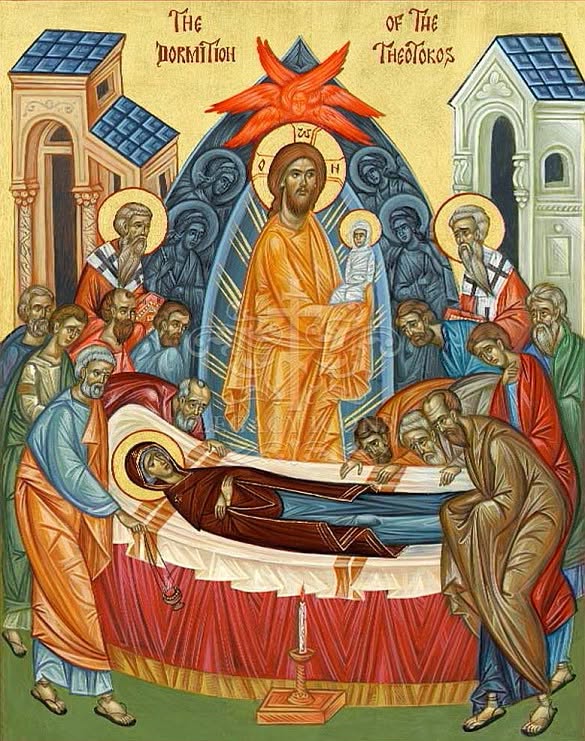
Since its inception, the Church has held the Blessed Virgin Mary in highest esteem. She is revered for Her virtue and righteousness, venerated for Her purity and piety, and accorded the venerable title of Theotokos, because she was divinely chosen to be the “bearer of God,” in whom the “Word was made flesh” (John 1:14).
Her ever-prominent role in the life of the Church, as well as the respect and devotion afforded Her as the example of supreme commitment to God, reminds us that, in the words of Fr. Alexander Schmemann, “She is the example, not the exception;” meaning that, we, too, can attain an honorable, devout, and righteous life by mirroring Her trust and devotion in God, coupled with a willingness to surrender, submit, and serve Him. She is the image of New Eve whose voluntary obedience counterbalanced Eve’s disobedience in the Garden of Eden.
Although Mary’s prominence and position is sadly downplayed by most Protestants following the 16th century Reformation, it is interesting to see how the Theotokos was viewed by the Early Church Fathers, those who received the Faith handed down directly from the Holy Apostles themselves.
For instance, St. Dionysius the Areopagite, Bishop of Athens, who was converted to Christ by St. Paul himself, visited the Mother of God in Jerusalem and afterward wrote about it to St. Paul:
“It is impossible for the human mind to grasp what I have seen not only with the eyes of my soul, but with my bodily eyes, too. I have seen with my own eyes the most beautiful and holy Mother of Our Lord Jesus Christ… That time was for me a time of supreme happiness, and I thank the Most High and Most-gracious God, and the Divine Virgin, the great Apostle John, and you [St. Paul], for having mercifully granted me such a great blessing,”
Another Church Father, St. Ignatius of Antioch, a disciple of the Apostle John, wrote this about the Blessed Virgin:
“If it is made possible, I intend to come to you in order to see the faithful gathered in Jerusalem, and especially the Mother of Jesus: they say of her that she is honorable, affable, and arouses wonder in all, and all wish to see her. But who would not wish to see the Virgin and to converse with her who bore the true God? With us she is glorified as the Mother of God and the Virgin full of grace and virtue. They say of her that she is joyful in troubles and persecutions, does not grieve in poverty and want, and not only does not get angry with those who offend her but does good to them still more… All who see her are delighted.”
At the Third Ecumenical Council held at Ephesus in 431 AD, St. Cyril, Archbishop of Alexandria, spoke out against the Nestorian heresy to champion and reaffirm Mary’s unique role in our salvation history, stating what the Church already believed and maintained: that Mary was indeed the Mother of God and that she carried in Her womb the Only-begotten Son of God, Who was both fully Divine and fully Human.